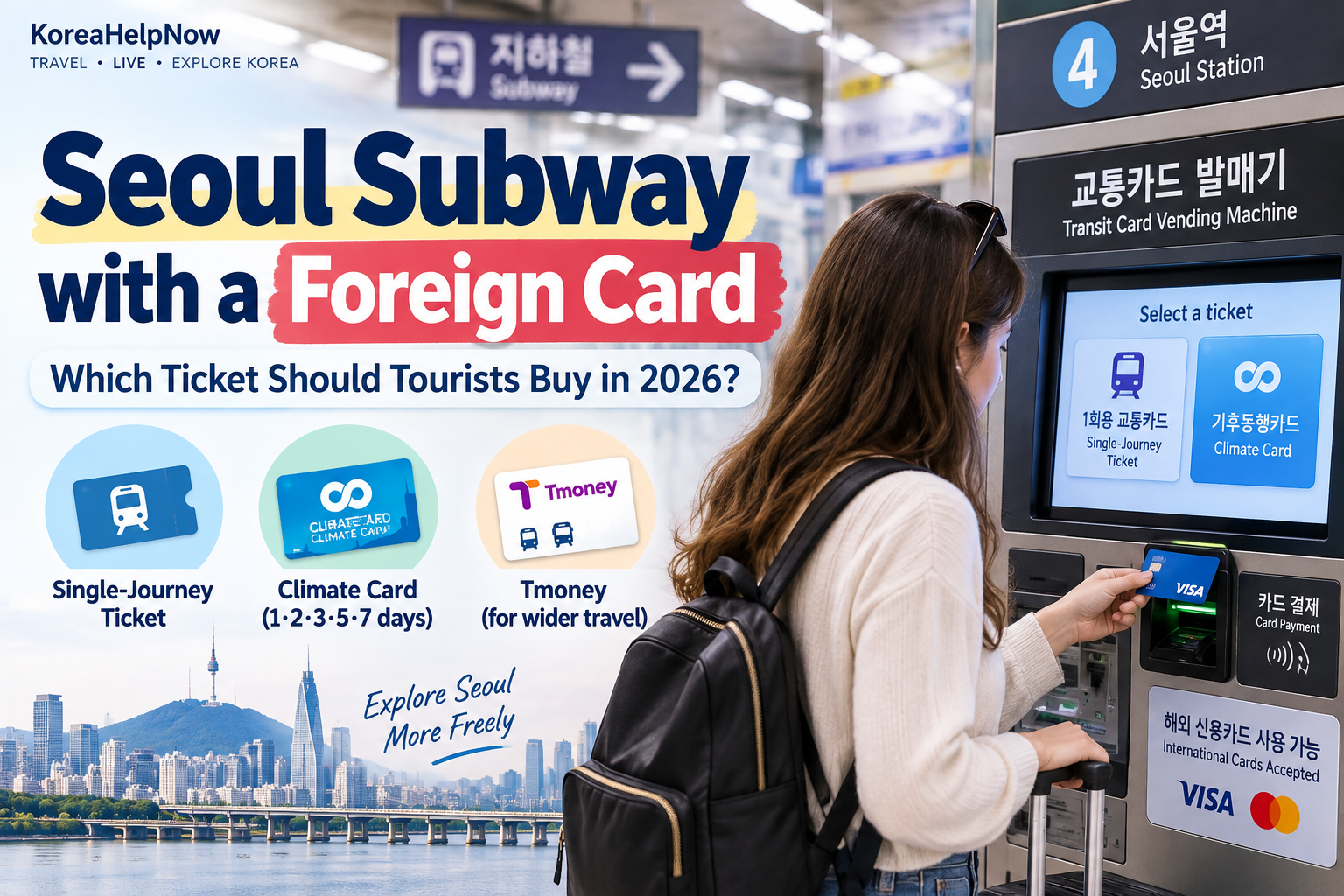
Getting around Seoul has become easier for international visitors in 2026.
If you arrive at a Seoul subway station with a foreign Visa or Mastercard, you may no longer need Korean cash just to buy your first subway ticket.
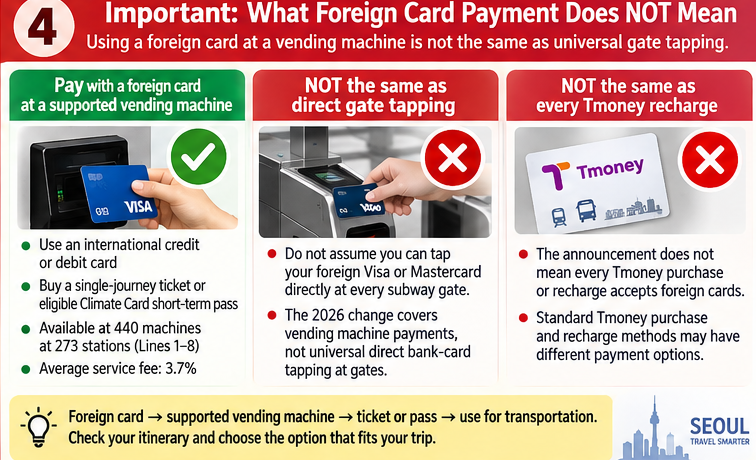
Using a foreign card to buy a subway ticket is not the same as tapping your foreign bank card directly at every subway gate.
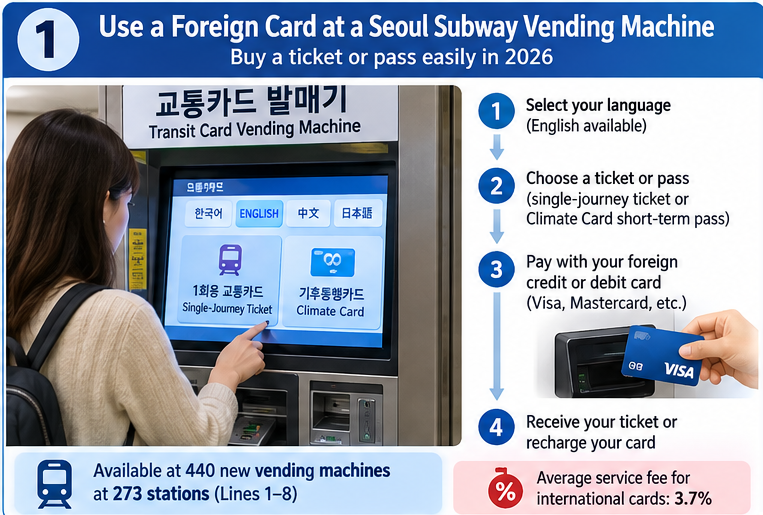
Since March 17, 2026, internationally issued credit and debit cards have been accepted at 440 new transit card vending machines at 273 stations on Seoul Subway Lines 1–8. At these supported machines, tourists can buy a single-journey ticket or purchase and recharge eligible Climate Card short-term passes. An average service fee of approximately 3.7% applies to international-card transactions.
Which subway ticket should you actually buy for your trip?
Can You Tap a Foreign Credit Card Directly at a Seoul Subway Gate?
Do not assume you can. The 2026 change officially covers international-card payments at supported ticket vending machines.
At these machines, eligible foreign cards can be used for single-journey subway tickets, Climate Card short-term passes, and recharging eligible Climate Card short-term passes.
Foreign card → supported vending machine → buy a ticket or pass → use that ticket or pass
Which Seoul Subway Ticket Should You Buy?
Your best starting option depends on where you are going and how often you expect to use public transportation.
1. You only need one subway ride
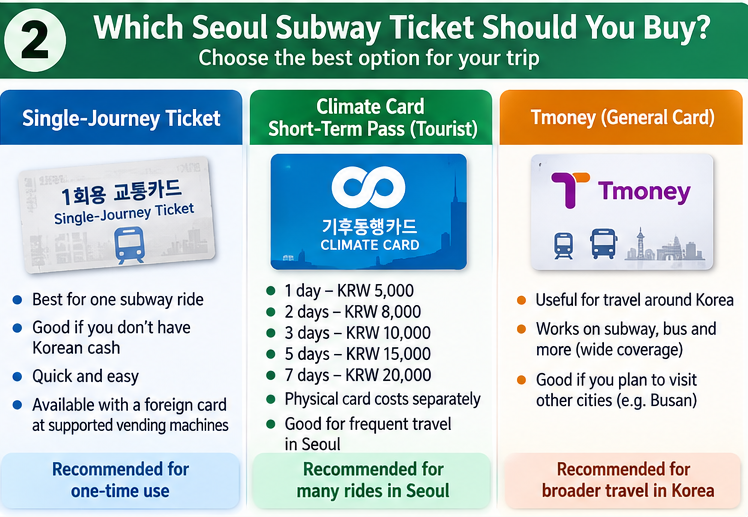
Consider a Single-Journey Ticket. This can be useful if you only need one subway journey, have not purchased a transportation card, do not have Korean cash, or need a quick way to reach your next destination.
Remember that a Seoul subway single-journey ticket is not a general transportation card for buses.
2. You will travel around Seoul many times
Consider a Climate Card Short-Term Pass.
- 1 day — KRW 5,000
- 2 days — KRW 8,000
- 3 days — KRW 10,000
- 5 days — KRW 15,000
- 7 days — KRW 20,000
The physical card itself costs separately. Consider both how often you will travel and whether your destinations are within the pass’s service area.
3. You are visiting Seoul and other Korean cities
A general transportation card such as Tmoney may be more practical than relying only on a Seoul-focused pass.
Frequent covered rides mainly in Seoul → compare the Climate Card
Travel around Korea → consider Tmoney
4. You are staying in Seoul for three days
Do not automatically assume that the 3-day Climate Card is the cheapest option. The current 3-day tourist pass costs KRW 10,000, excluding the separate cost of the physical card. Compare it with the number of rides you actually expect to take.
5. You just arrived at Incheon Airport
First solve your Incheon Airport → Seoul journey. Airport transportation has its own options, including airport railroad and airport buses. After reaching Seoul, choose the transportation option that fits the rest of your trip.
Climate Card or Climate Pass? Important September 2026 Change
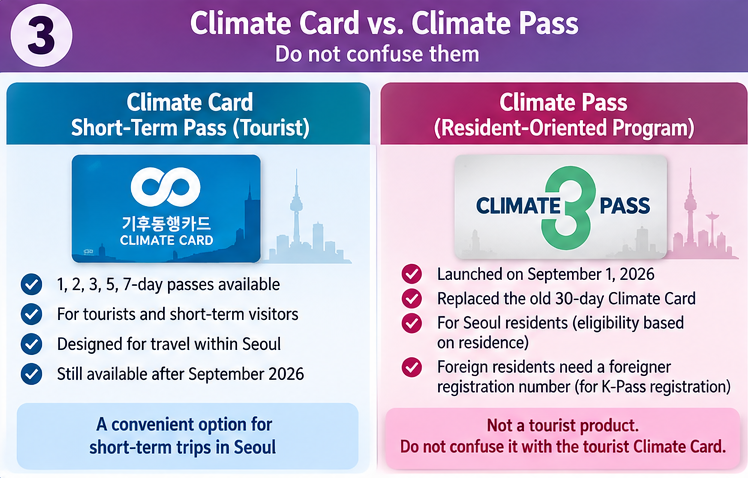
The old 30-day prepaid Climate Card could only be recharged through August 31, 2026, and the new Climate Pass launched on September 1.
But the tourist Climate Card did not disappear. The 1-, 2-, 3-, 5- and 7-day Climate Card short-term passes continue to be available.
Climate Card Short-Term Pass → tourist/visitor option
Climate Pass → separate resident-oriented program
Climate Pass eligibility is residence-based, and foreign residents need a foreigner registration number to register through the K-Pass system.
Where Can You Pay with a Foreign Card?
Look for one of the new international-card-compatible transit card vending machines. Seoul introduced 440 machines across 273 stations on Subway Lines 1–8. Do not assume that every machine throughout the entire metropolitan rail network has exactly the same foreign-card functionality.
Is There an Extra Fee for Using a Foreign Card?
Yes. According to the Seoul Metropolitan Government, eligible purchases and recharges made through the supported system with internationally issued credit or debit cards are subject to an average service fee of approximately 3.7%. Your card issuer may separately charge foreign transaction or currency-conversion fees.
Does This Mean Every Tmoney Recharge Accepts Foreign Cards?
No such general conclusion should be made from the 2026 subway announcement. The officially announced expansion covers eligible single-journey tickets and Climate Card transactions at supported new vending machines. It does not establish that every ordinary Tmoney purchase or recharge channel accepts every foreign credit card.
5 Common Mistakes Tourists Should Avoid
Mistake 1: Trying to tap your foreign Visa directly at the gate
Foreign-card payment at a supported vending machine is not the same as universal direct bank-card tapping at subway gates.
Mistake 2: Assuming every Tmoney recharge accepts your foreign card
The new system does not establish universal foreign-card acceptance for ordinary Tmoney recharge methods.
Mistake 3: Buying a Climate Card without checking your itinerary
A pass designed around Seoul transportation may not be the best solution for a trip that includes significant travel outside Seoul.
Mistake 4: Following an old 30-day Climate Card guide
The long-term program changed in September 2026. Tourist short-term Climate Card passes remain, but the old 30-day prepaid system and the new Climate Pass should not be confused.
Mistake 5: Forgetting the foreign-card fee
The supported international-card transactions carry an average service fee of approximately 3.7%, and your card issuer may charge additional fees.
Quick Decision Guide
One subway journey → Single-Journey Ticket
Many covered rides during a short Seoul trip → Compare a Climate Card Short-Term Pass
Seoul plus other Korean cities → Consider Tmoney
Just arrived at Incheon Airport → Choose your airport-to-Seoul transportation first
Living in Seoul → Check whether the new Climate Pass applies to you
This is a decision guide, not a guarantee that one option will always be the cheapest.
What If Your Foreign Card Does Not Work?
- Check that you are using an international-card-compatible vending machine.
- Check that you are purchasing a supported ticket or pass.
- Check that your internationally issued card is eligible.
- Check whether your bank blocked the overseas payment.
The rollout covers 440 new machines at 273 stations on Lines 1–8. That should not be interpreted as a guarantee that every ticket machine in the entire metropolitan subway network accepts foreign cards.
30-Second Checklist Before You Pay
- How many rides will I actually make?
- Am I staying mainly in Seoul?
- Will I travel to another Korean city?
- Am I starting at Incheon Airport?
- Do I need one journey or several days of covered rides?
- Am I looking at a tourist Climate Card or the new Climate Pass?
- Am I using a foreign-card-compatible vending machine?
- Have I considered the foreign-card service fee?
FAQ
Can tourists use foreign credit cards on the Seoul subway?
Yes, eligible internationally issued credit and debit cards can be used at supported new vending machines to purchase single-journey tickets and eligible Climate Card short-term passes.
Can I tap my foreign Visa or Mastercard directly at a Seoul subway gate?
Do not assume so. The 2026 expansion discussed here concerns payments at supported ticket vending machines, not universal direct foreign-bank-card tapping at every subway gate.
Can I buy a single subway ticket with a foreign card?
Yes. Single-journey subway tickets are included in the international-card payment system at supported new vending machines.
Can tourists still buy a Climate Card in September 2026?
Yes. The 1-, 2-, 3-, 5- and 7-day Climate Card short-term passes continue to be available.
Is Climate Pass the same as the tourist Climate Card?
No. The new Climate Pass is a separate resident-oriented program. Tourist Climate Card short-term passes continue to exist.
Which is better for tourists: Climate Card or Tmoney?
It depends on your itinerary. For frequent covered travel mainly within Seoul, compare the Climate Card tourist pass. For broader transportation around Korea, Tmoney may be more practical.
Is there a fee for using a foreign card?
Seoul states that an average service fee of approximately 3.7% applies to eligible international credit/debit-card transactions through the supported vending-machine system. Your card issuer may charge additional fees.
What should I do if my foreign card is rejected?
First confirm that you are using a compatible machine and purchasing an eligible product. If those are correct, check whether your bank has blocked the overseas transaction and consider another available payment method if necessary.
The Simplest Answer
One subway ride? → Single-Journey Ticket
Many rides during a short Seoul trip? → Compare a Climate Card Short-Term Pass
Traveling around Korea? → Consider Tmoney
Just landed at Incheon Airport? → Solve your airport-to-Seoul trip first
And remember: Foreign card → supported vending machine → ticket/pass → transportation does not automatically mean foreign credit card → tap directly at every subway gate.
Leave a Reply